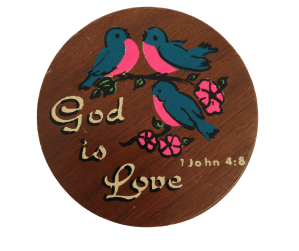
This little plaque was given to me at my 8th birthday party, and it’s one of the few things I took with me when I left home as a young teenager. Now, I don’t think anyone, even the most religious amongst us would consider giving something like this to a child now. And in retrospect, along with being almost 60 years ago, my 8th birthday also took place in a small town in southern Manitoba that was and still is heavily influenced by the Mennonites. And is visibility religious in ways that I have only see fleetingly here in Nova Scotia.
But that core message, God is love, which is not from our scripture reading, or the Leonard Cohen song I’m highlighting today, remains. God is love. The passage from 1 Corinthians 13 is often read at weddings, sometimes funerals, but it was never intended that way. I’ll unpack some of that in a few minutes, but first let’s listen to what may be very familiar words to some of you.
4 Love is patient; love is kind; love is not envious or boastful or arrogant 5 or rude. It does not insist on its own way; it is not irritable; it keeps no record of wrongs; 6 it does not rejoice in wrongdoing but rejoices in the truth. 7 It bears all things, believes all things, hopes all things, endures all things. 8 Love never ends.
1 Corinthians 13 was written to a divided and competitive church in the busy, status-driven city of Corinth. Corinth was a wealthy, diverse, and competitive port city in ancient Greece. Rebuilt as a Roman colony in 44 BCE, it sat at a major crossroads for trade, culture, and ideas. With prosperity came sharp social divisions between rich and poor, enslaved and free, locals and outsiders.
The city was known for status-seeking, public performance, and competition. Success was measured by visibility, eloquence, and power. These cultural values shaped the life of the early Christian community there. The believers there were enthusiastic about spiritual gifts, especially the ones that drew attention, but they were using those gifts in ways that caused harm and division. Paul places this chapter right in the middle of two chapters on his teaching on spiritual gifts to make a clear point: no matter how impressive our faith, knowledge, or abilities may seem, they are empty if they are not rooted in love.
The love Paul describes is not sentimental or passive. It is patient, kind, and enduring, and it runs directly against a culture shaped by power, performance, and pride. In a community tempted to measure faith by visibility and success, Paul insists that love is the true measure of spiritual maturity and the only thing that truly lasts.
I admit, I have had difficulty with this passage over the years. Especially that last line… love never ends… We all know cases where love ends… divorces happen, friendships break down, siblings disagree and never speak to one another… church members leave.
But… if you’ll let me digress for a moment… inside each one of us, are all the other iterations of who we are. The easiest way to understand that idea is to think about a time when you got together with your siblings if you have them… or at a high school or workplace reunion. Once you get past the updates on what you are up to, did you fall into old patterns behaviour in those situations? The old you is still there… still part of you… so even as a divorced person who had difficulty with that line, “love never ends,” inside me is still the very young woman who loved my son’s father…
Paul wasn’t talking about feelings… he was talking about behaviour. He was talking about agape love… the sacrificial kind of love that wants the best for the other person. Not being a doormat, but being ready to serve others, the whole community, to love as Jesus loves us. It may seem impossible, but it is something to strive for. Love that is in the service of others rather than self.
I paired the scripture reading with Leonard Cohen’s Dance Me to the End of Love. For those of you who read my midweek message, I included a YouTube video of him singing it. Here are just two verses:
Dance me to your beauty with a burning violin
Dance me through the panic ’til I’m gathered safely in
Lift me like an olive branch and be my homeward dove
Dance me to the end of love
Dance me to the children who are asking to be born
Dance me through the curtains that our kisses have outworn
Raise a tent of shelter now, though every thread is torn
Dance me to the end of love
Notice the biblical reference: Lift me like an olive branch and be my homeward dove. What does that remind you of? (Noah’s ark)
Cohen once spoke of this song as being inspired by musicians playing in concentration camps, creating beauty while surrounded by unimaginable pain. It is a reminder that love does not wait for ideal conditions. Love shows up anyway.
Love shows up.
And that takes courage… it takes courage to remain in the dance of love. Remember where the word courage comes from? From the French, ‘en couer’ to take heart. It takes courage to keep using our spiritual gifts to build up the entire community. It takes courage to keep our eyes open to the pain of the world without letting it overwhelm us.
It takes courage to keep being a witness to the increased fascism south of the border and to speak out against it in our own context. So perhaps the invitation before us is not to feel love perfectly, or to pretend that relationships never fracture, but to choose love as a way of being. To practice commitment when it would be easier to withdraw. To act with kindness when we feel hurt or afraid. To hope when cynicism feels safer.
This is the courage Paul speaks of, and it is the courage Cohen sings into being. Love that bears and believes and endures is not naive. It is brave. It is the decision to stay engaged with one another and with the world, even when the music falters and the floor feels unsteady. To stay in the dance of love is to trust that God is still at work in the torn threads and unfinished steps of our lives. It is to show up for one another, not because it is easy or guaranteed to succeed, but because love is what lasts.
So may we dance on. May we choose love that serves rather than performs, love that shelters rather than impresses, love that shows up anyway. And may God, who is love, give us the courage to keep dancing all the way to the end of love.
Thanks be to God for the challenge and the opportunity, amen.
1 Corinthians 13: 4-8
Dance Me to the End of Love – Leonard Cohen
January 11, 2026
 St. James United Church Dartmouth