
Have you ever been a stranger? Started a new job? Joined a new family? Perhaps the first time you met your in-laws? What was that like? How did you feel? Disorienting? You didn’t know the ‘rules or norms’ for behaviour. The inside jokes.
What about travelling alone to a foreign country? Where you didn’t speak the language, or only had a rudimentary understanding of it? When I landed in Dublin a few years ago after an overnight flight with little sleep, and no access to coffee before going through customs, I could almost swear that the customs official was NOT speaking English! 😉 And he probably thought that I wasn’t either. He seemed very concerned that I wanted to stay in Ireland, despite the fact that I had a return ticket booked already.
One of the opening scenes in the movie Peace by Chocolate is of Tareq Haddad on a plane headed to Canada. He’s the only one of his family to get a visa and he’s hoping to continue his medical studies and become a doctor. He’s spent the last few years of his life in Lebanon, in a refugee camp, with his parents, sister, and niece after being bombed out of their home and livelihood in Syria. He settled somewhat into live in small town Antigonish, population 7000, compared to Damascus, population 5 million.
His parents arrive a few months later, his father doesn’t feel right accepting money without working for it, but the only thing he knows how to do is make chocolate and so that’s what he starts doing… out of the kitchen in the house they have been provided. Peace By Chocolate is the story of how that enterprise grew into a common household name.
An article in Global Heros said this: By 2022, Peace by Chocolate will hire 50 refugees at its facilities across Canada and provide mentorship and guidance to 10 refugee startups. Peace By Chocolate also donates 3-5% of its profits to the Peace On Earth Society—a Nova Scotia-based organization that donates funds to peace-building projects around the world. (https://www.globalheroes.com/peace-by-chocolate-a-story-of-new-beginnings/)
So, what does the story of a Muslim Syrian family have to do with us? Well, let’s listen to what Moses has to say. Moses that baby who was rescued from the river, who grew up as an Egyptian prince, who led the Israelites out of slavery, where they wandered for 40 years. It’s recorded in Deuteronomy 10:17-19:
17 For the Lord your God is God of gods and Lord of lords, the great God, mighty and awesome, who is not partial and takes no bribe, 18 who executes justice for the orphan and the widow, and who loves the strangers, providing them with food and clothing. 19 You shall also love the stranger, for you were strangers in the land of Egypt.
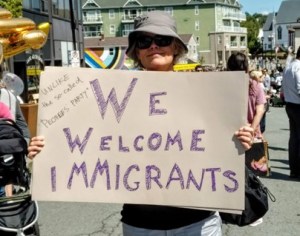
Love the stranger, for you were strangers in the land of Egypt. Love the stranger. We don’t always love the stranger do we? Especially when the stranger is different from us.
When resources seem to be in short supply. When our way of life seems to be threatened. I understand… it can be scary to think that our world is static and then find out it isn’t. Almost half a million people came to Canada last year from other countries.
When housing and medical care is scarce, and food costs are rising, it can be really easy to find an obvious target to blame. Immigrants. And especially these days, immigrants that don’t look like us.
When Canada welcomed thousands of European immigrants in the post war years, they weren’t so easily identifiable were they? And it was easy to find things in common. But Canada has always been a country of immigrants, a full 20% of the 2020 census identify as immigrants, and if you want to go way back, were any of our ancestors from this land? Mine weren’t.Mine were from Russia and Scotland, on one side fleeing religious persecution and the other probably in the clearing of the Scottish Highlands.
What kind of world is God inviting us to create? One of fear of the stranger or one of welcoming the stranger? One where fear is God? Or God is God. Let’s listen to some further words from Deuteronomy, this time from a little bit earlier on, it’s still Moses speaking, in fact, it’s part of the same discourse, and it’s words that Jewish people often have on a scroll inside a mezuzah at the entrance of their home.
Hear, O Israel: The Lord is our God, the Lord alone. You shall love the Lord your God with all your heart, and with all your soul, and with all your might. Keep these words that I am commanding you today in your heart. Recite them to your children and talk about them when you are at home and when you are away, when you lie down and when you rise. Bind them as a sign on your hand, fix them as an emblem on your forehead, and write them on the doorposts of your house and on your gates.
You shall love the Lord your God with all your heart, and with all your soul, and with all your might. That is known to Jewish people as the Shema… they recite it every day…
Patrick D. Miller, in Deuteronomy, Interpretation, a Bible Commentary for Teaching and Preaching says this about these passages: …hearing the Lord your God, walking in the ways of the Lord, loving the Lord, serving the Lord your God, keeping the commandments of the Lord. And all these completely synonymous acts, which provide varying images and rich theological vocabulary to speak about our commitment to God, are to be done with all your heart and with all your soul: that is, they are to be carried out wholeheartedly, with your total being That is, the Lord loved your ancestors and chose you…The call to love the stranger is grounded in God’s love of the stranger or sojourner and Israel’s own experience as strangers and sojourners in Egypt. …(Louisville, KY: J. Knox Press, 1990), 124–126 paraphrased)
You shall love the Lord your God with all your heart, and with all your soul, and with all your might. You heard Jesus use those words when he was asked what was the greatest law… he added and love your neighbour as yourself! He also said this in John 13: 34-35
I give you a new commandment, that you love one another. Just as I have loved you, you also should love one another. By this everyone will know that you are my disciples, if you have love for one another.’
He’s speaking to his disciples towards the end of his time with them. And he wants love to be their guiding principle. Love, not fear. Despite their oppression by the romans, he said love was to be their guiding principle. Imagine a world where we didn’t have the courage to love the stranger. Imagine a world where fear dictated our actions instead of love. Now imagine a world where love does. When we can imagine it, we can create it!
The story of the Haddads and Peace by Chocolate isn’t just about chocolate or business success; it’s a story about the transformative power of love, the kind of love that reaches beyond borders, beyond differences, and beyond fear.
Jesus calls us to this love—a love that is active, visible, and life-changing. “By this everyone will know that you are my disciples, if you have love for one another.”
It’s not enough to feel love; we must show it, especially to those who are different from us, to those who might feel like strangers in our midst. What kind of community do we want to be? One that turns inward and closes off, or one that opens its arms wide, welcoming the stranger with the love that Christ has shown us? The choice is ours.
But let us remember that in loving the stranger, we are fulfilling the greatest commandments—to love God with all our heart, soul, and might, and to love our neighbor as ourselves. As we leave today, let us carry this love into our homes, our workplaces, and our communities. Let us be known by our love, for it is in this love that we truly reflect the heart of God.
Thanks be to God for the challenging and the opportunity of living this out, amen.
Deuteronomy 10:17-19
Deuteronomy 6: 4-9
John 13:34-35
August 18, 2024
Reel Theology – Peace By Chocolate
© Rev. Catherine MacDonald
 St. James United Church Dartmouth