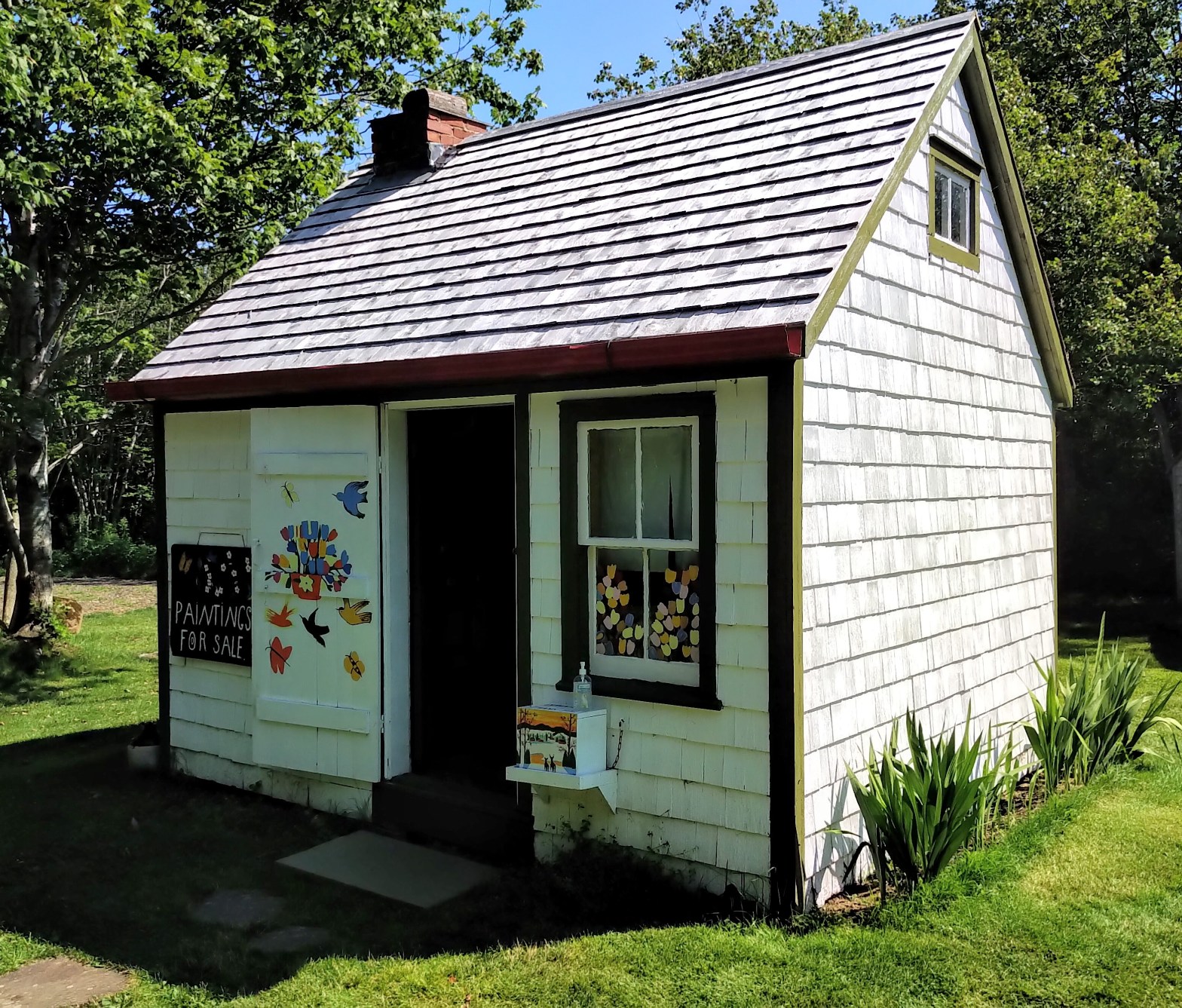

Folk artist Maud Lewis likely never imagined from her tiny house in Marshalltown, NS, that her life would be depicted in a film. Maud Lewis was born in 1903 in South Ohio, NS, not far from Yarmouth. She married her husband, Everett, in 1938 and the two lived without electricity or running water in a modest, one-room home with a loft that Lewis covered in brightly painted flowers, butterflies and birds. Crippled by rheumatoid arthritis, Lewis spent her days creating small paintings that she advertised for sale on a roadside sign. Her paintings were selling for around $10 when Lewis died in 1970.”She worked so hard at it and in such tough conditions sometimes.” (Wikepedia)
I have no idea whether Maud Lewis had any sort of faith; the only mention of church in the film is when she and Everett got married. And nothing I have read about her life has mentioned any religious connection. Nevertheless, her life has deep theological connections. This reading from 2 Corinthians could have been written about Maud.
7 But we have this treasure in jars of clay to show that this all-surpassing power is from God and not from us. 8 We are hard pressed on every side, but not crushed; perplexed, but not in despair; 9 persecuted, but not abandoned; struck down, but not destroyed. Each one of us is cracked in some way,
Maud was in more visible ways, but each of us carries hurt and pain that can hamper our ability to create lives of beauty and truth. She persisted, despite her circumstances, in creating a life that was full of beauty. One of my colleagues, Kassandra Matthews, upon seeing her home at the Art Gallery this summer, wrote this: Her story is a testament to the triumph of the human spirit over adversity. Despite facing severe physical limitations and personal hardships, being devalued by almost everyone closest to her, she channeled her boundless creativity into her vibrant, joyful paintings. Her resilience and unwavering passion for art, despite living in poverty and dealing with chronic pain, is a source of inspiration. Maud’s life and work remind us that true beauty often emerges from the most unlikely places, shining brightly even in the face of life’s greatest trials.
From where did she get her strength? Her determination? Her perseverance? I don’t know and we will never know. But we can ask ourselves how we are strengthened to live lives of beauty and persistence? Our world and the church is going through major upheaval. Covid showed the cracked in our systems… cracks that we tried to patch over and pretend they didn’t exist for years. That patching enabled us to pretend that deep cultural shifts weren’t taking place that affected us.
Again, Paul writes, 10 We always carry around in our body the death of Jesus, so that the life of Jesus may also be revealed in our body. 11 For we who are alive are always being given over to death for Jesus’ sake, so that his life may also be revealed in our mortal body. 12 So then, death is at work in us, but life is at work in you. “We are bewildered at times, but we do not give in to despair. We have been knocked down, but we are not destroyed. We always carry around in our bodies the reality of the brutal death and suffering of Jesus. As a result, His resurrection life rises and reveals its wondrous power in our bodies as well.”
My friends, I am guilty at times of thinking it is all up to us… and make no mistake, it is up to us to work with Jesus for the mending of the world. But Jesus’ life, death and resurrection, and the wounds of his body, are reminders that we do not engage in the work of the healing of the world by ourselves. We lean on Jesus, always on Jesus. A human, like us, yes. But also one who had such a deep connection to God that it sustained him all his days. One that was fostered through his upbringing, his studies of the Hebrew Bible, his encounters in the wilderness and his engagement with the people and systems around him. We do not, cannot, create the new heavens and a new earth without relying on something other than ourselves. The work is too big to undertake it on our own. So, like Jesus, we can find sustenance and hope in ancient words… like the words from Isaiah.
28 Have you not known? Have you not heard?
The Lord is the everlasting God,
the Creator of the ends of the earth.
He does not faint or grow weary;
his understanding is unsearchable.
29 He gives power to the faint,
and strengthens the powerless.
30 Even youths will faint and be weary,
and the young will fall exhausted;
31 but those who wait for the Lord shall renew their strength,
they shall mount up with wings like eagles,
they shall run and not be weary,
they shall walk and not faint.
This passage from Isaiah was written in the times of the Babylonian captivity. When there was no prospect of deliverance. And yet, it is a hopeful passage… a passage that conveys faith in something beyond themselves and their particular circumstances. It’s a passage that is applicable today as it was when it was written. It does not mean passive waiting, but rather active trust, knowing the God will somehow redeem our circumstances. And that we must nourish our faith. Our faith, your individual faith, and our collective faith cannot be nourished without feeding it. And it needs more than once a week feeding… 😉 Daily Bible reading can nourish us… looking for something of beauty every day can nourish us…creating something beautiful every day can nourish us… And our faith is not nourished by only scripture. It is nourished by creating beauty no matter what our circumstances.
We are no physically enslaved, but we are enslaved by many things… things of our own creating. The idea that church has to be large to be faithful… The belief that we don’t have enough to do whatever God is calling us into. Our ancestors in the faith would be shocked at how much we have, even as we think we have so little. And we cling so hard to what was that we can’t open our hands to the future that God is calling us to. No matter our circumstances, we can focus on creating something beautiful, despite our circumstances, in fact, taking our circumstances and making something beautiful with them?
Look at this small space that Maud Lewis had… think of her enduring legacy of beauty. Maud Lewis didn’t wait… she just created beauty… on anything she could get her hands on… the very walls that contained her life. Despite pain, despite poverty, despite physical disability. She created beauty… and people were drawn to it. We do not have the challenges of a Maud Lewis; in fact, some of us might better rise to the challenge of creating a more beautiful world if we weren’t so comfortable. 😉
What feeds your soul? What makes you come alive? What takes you beyond yourself when you feel as if you are connected to all creation?
Maud Lewis created beauty from the time she was a little girl, despite her physical handicaps, despite the circumstances of her birth, she persevered in creating beauty all around her. Can we, with so many more advantages, do likewise? Your challenge this week is to both notice beauty and create beauty… and send me photos, I’ll use them in a slide show next week. Beauty that exists in this broken world.
Thanks be to God for the challenge and opportunity of creating beauty in this broken world. Amen.
Isaiah 40: 28-31
2 Corinthians 4: 7-12
(c) Rev. Catherine MacDonald
 St. James United Church Dartmouth